I arrived at SpringCard with a two-year technical degree (DUT GEII) and six months as a technician under my belt, doing support on PCB routing. I left three years later having designed the antenna of the company’s flagship product and running the methods department. In between: an engineering apprenticeship at Polytech Sorbonne and a small company where you touch everything because there are only nineteen of you.
That’s the whole point of a small outfit: the distance between “I understand the schematic” and “my name is on the top half of a product in production” is measured in months, not years.
the ground: a French contactless house
SpringCard designs and manufactures in France RFID/NFC couplers and readers at 13.56 MHz, for access control, transit and parking. Born in the early 2000s as a spin-off from Noralsy’s design office, Springcard brand in 2005, SpringCard SAS in 2015. A 100% B2B model, with clients like Thales, Sagem, Aéroport de Paris, and the 35,000 readers fitted to Paris’s Vélib’ stations.
The organization is simple and telling: hardware in Palaiseau (under Jérôme Chalbot, my mentor), software in Angers, assembly at partner Prod2J. A short chain of command, plenty of autonomy per department. The kind of place where an apprentice is handed real projects because there’s no one else to carry them.
the projects that shaped me
Before the Puck, two Cykleo products served as full-scale testing grounds.
The CykleoRail, early in the apprenticeship, is a bike-presence detector for a docking station. Weighing wasn’t an option given how heterogeneous the fleet is, so detection is done with ultrasound: pure analog (filtering, op-amp-based amplification) exactly what I was covering in my analog electronics classes at the same time. And since the stations are often offline, that’s where I put in LoRa for data backhaul, in parallel with my IoT courses.
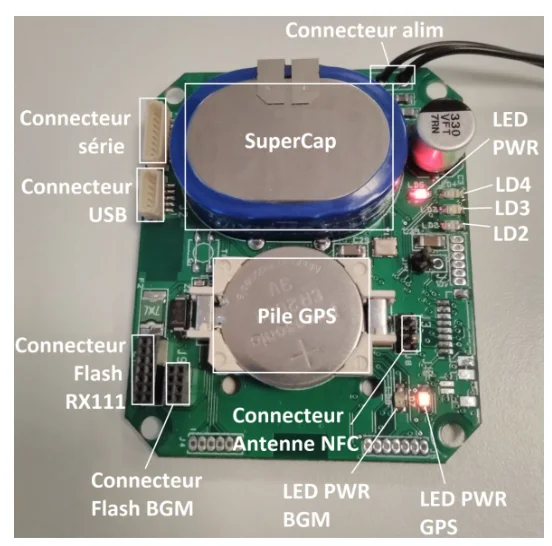
The Biketracker, again for Cykleo, moved me to the other side: V-model design, but above all a feasibility study, a commercial offer, direct exchange with the client, under Johann Dantant’s supervision. That’s where I understood that a hardware project is won as much on component choice (availability, obsolescence, we favored Renesas for longevity) as on the schematic itself.
the Puck, and its antenna
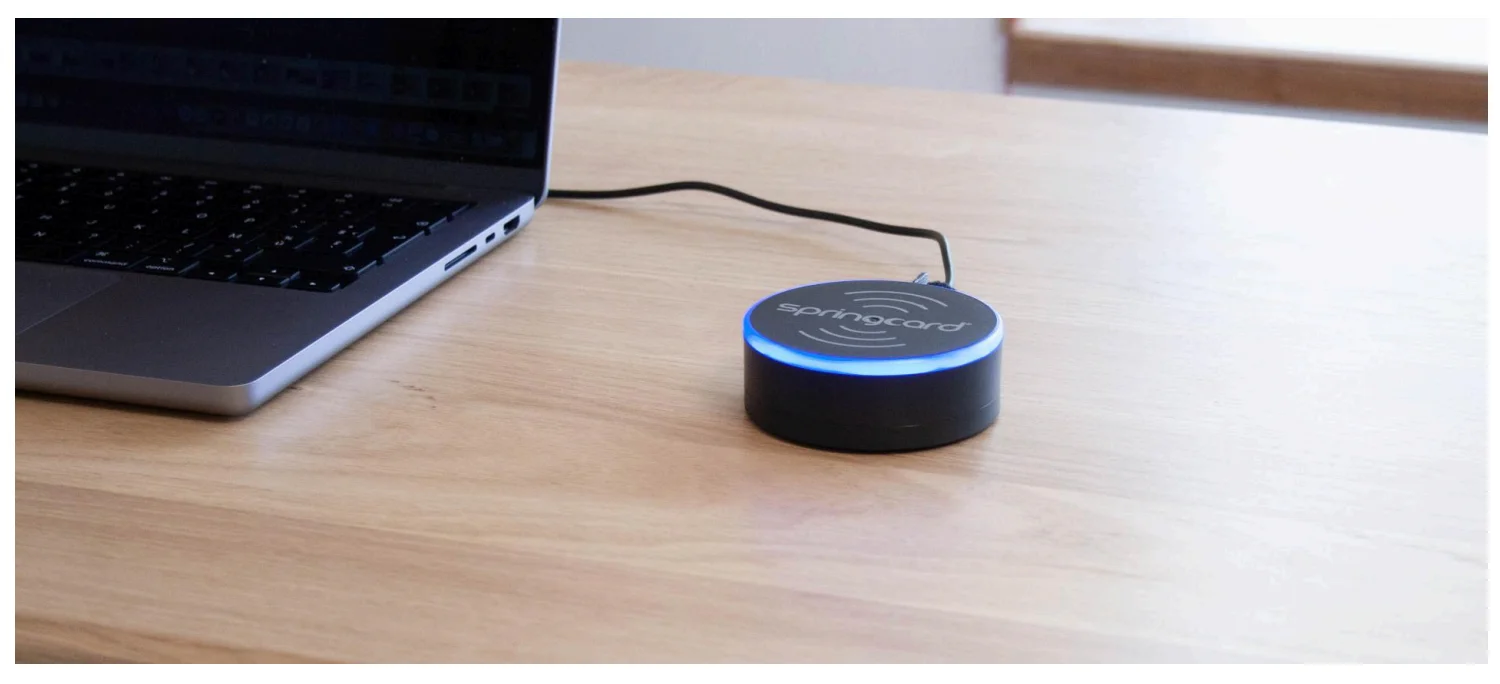
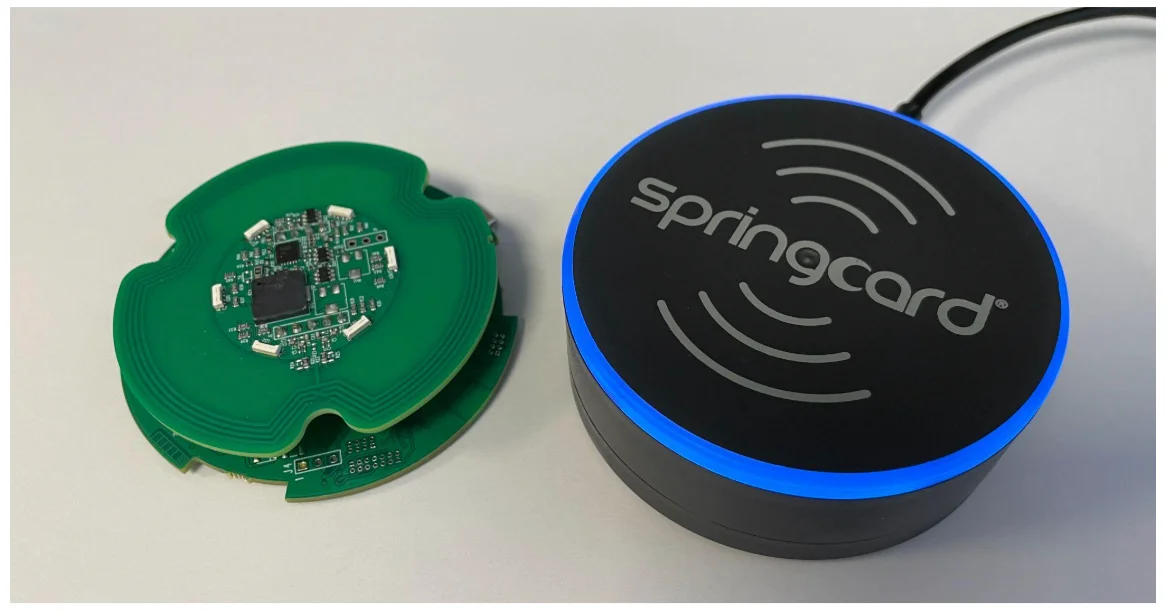
The Puck is the desktop reader meant to replace a good chunk of the portfolio by concentrating production on a single product. It’s assembled in two parts at the factory: the Puck CPU, and the top part, the Puck antenna, which I worked on.
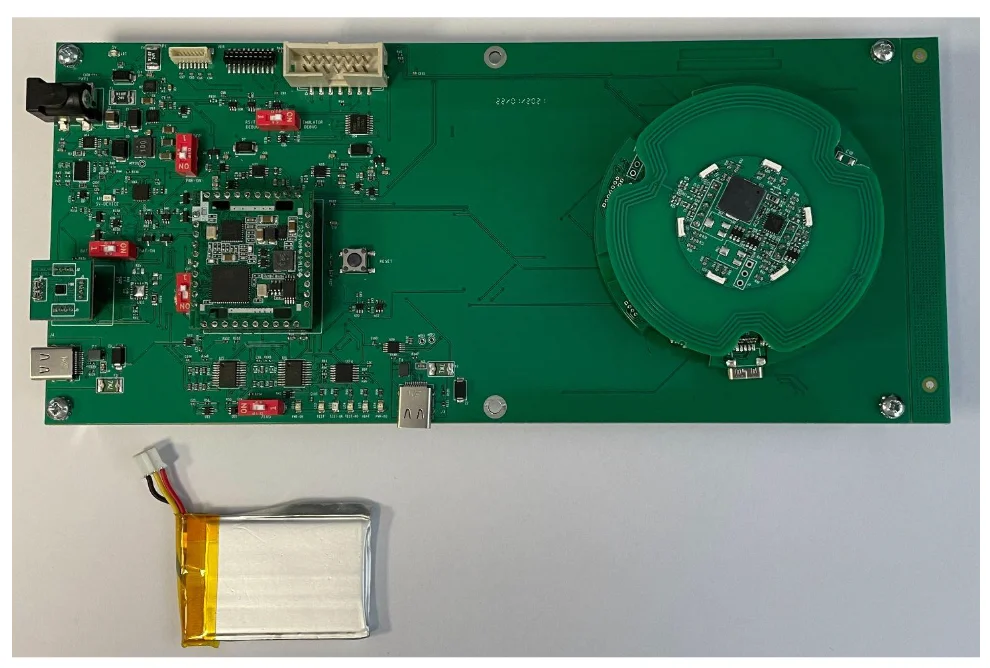
This board isn’t just a loop. It stacks several disciplines onto a few square centimeters:
flowchart TD
  MCU["Renesas RL78 microcontroller<br/>(slave, FreeRTOS)"] --> ANT["RFID antenna<br/>tuned 13.56 MHz · 50 Ω"]
  MCU --> LED["RGB LEDs<br/>(direct drive)"]
  MCU --> BUZ["Buzzer<br/>(via MOSFET)"]
  DCDC["DC/DC power supply"] --> MCU
  ANT -. "inductive coupling" .-> CARD["NFC card / tag"]
On the analog side, the RFID antenna has to be tuned to respond best at 13.56 MHz (ISO 18000-3), with a matching network bringing the trace impedance back to 50 Ω. It’s a balanced antenna: a perfect tuning on an empty bench is worthless if it collapses the moment a hand or an enclosure comes close, so you design for the real case, not for the ideal measurement. Around it, RGB LEDs and a buzzer driven by the microcontroller through MOSFETs, and a DC/DC power supply.
On the firmware side, the RL78 runs FreeRTOS as a slave: it answers commands from the rest of the product. It’s the kind of architecture I still build today in embedded work, and this board is where I laid the foundations.
methods lead: where design meets the factory
In November 2020, the president handed me the methods department. A change of focus: you no longer design the product, you make sure it manufactures fast, well, and without breakage. That’s the year I saw why a good schematic isn’t enough.
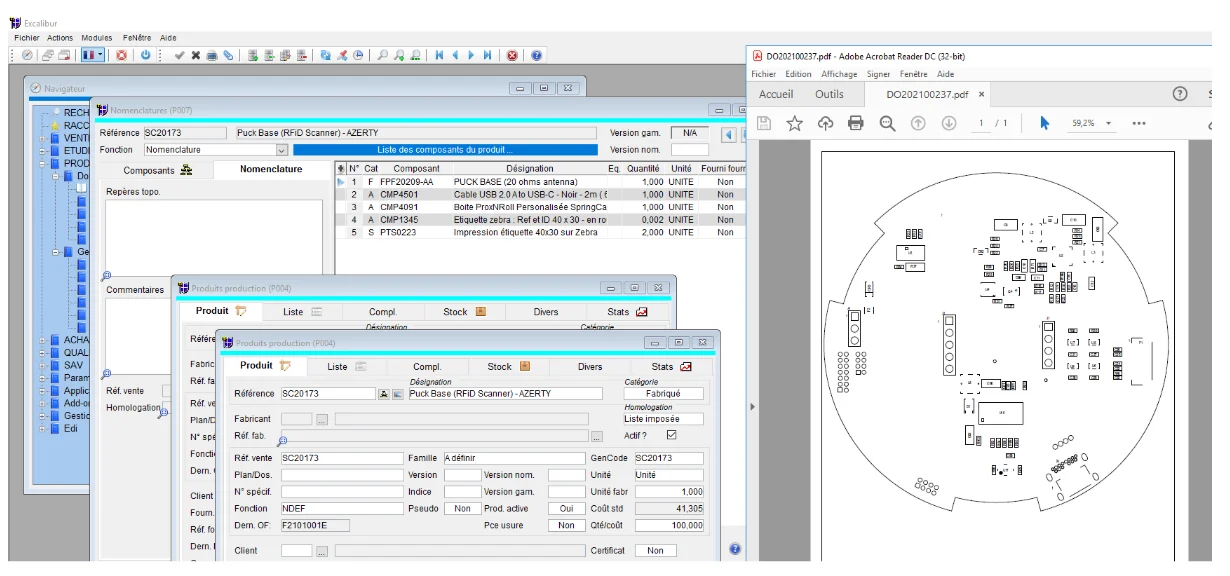
Two fixes sum up the spirit of the role, because they’re invisible in simulation and brutal in volume.
On the K663 OEM module with a balanced antenna, prototypes passed with no problem. In pre-production, at high volume, over 37% of output came out with soldering defects: a mis-sized footprint, undetectable on a single unit but blowing up at scale. Resize the footprint, problem solved.
On the Puck, the two parts are hand-soldered at seven points. The two ground pins refused to heat properly: the antenna’s ground plane dissipated too much, the solder dragged. I had the ground spacing modified on the gerber to cut soldering time, and therefore technician time per product, and therefore the cost of that step.
flowchart LR
  HW["Hardware schematic<br/>(R&D team)"] --> METH["Methods:<br/>product analysis"]
  METH --> CDC["Test bench spec<br/>(requirements · FMEA)"]
  CDC --> BANC["Bench design<br/>(V-model)"]
  BANC --> PROTO["Prototype tests<br/>in factory conditions"]
  PROTO -->|"OK"| GAMME["Manufacturing process"]
  PROTO -->|"KO"| CDC
The rest of the role revolved around that: inventory and overhaul of the test benches (some for discontinued products, others carrying twenty years of accumulated functions), design of new benches in V-model, BOM management under Excalibur to absorb the Covid component shortage without drifting from the spec or the target price, and even packaging, the story of the 2 m USB-C cable we ended up having delivered pre-coiled at the right diameter so the technician wouldn’t unwind and rewind it for every box.
Finally, I built the after-sales service almost from scratch: an RMA process, repair documentation written for a technician with no electronics background, and internal training (the “Springcard Academy”) on general electronics and soldering 0201 components. The idea: that everyone walks away with a real skill, not just labor.

what I take away
Three things stuck. The DFM reflex: a product is designed to be manufactured, not just to work on the prototype. The idea that reality always overrules simulation, learned one detuned antenna and one too-greedy ground plane at a time. And team and project management, which pushed me to pair Polytech with a program at IAE Paris.
A nineteen-person company doesn’t teach you one specialty, it teaches you the whole chain: from op-amp to gerber, from client to factory technician. To kick off an engineering career, it’s hard to beat.