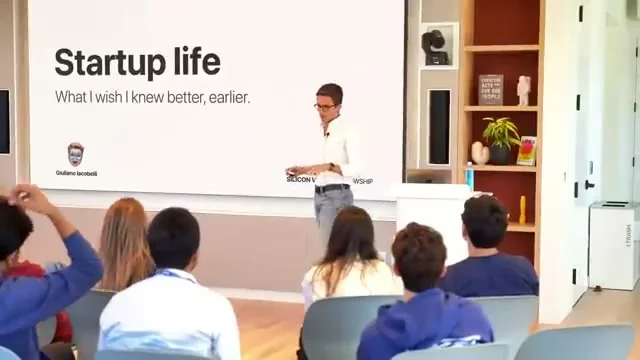
I watched a talk by Giuliano Iacobelli, an Italian founder whose startup ended up acquired by Apple, and it’s the most honest account of startup life I’ve heard in a long time. No heroic storytelling, no magic recipe. His opening warning sets the tone: his advice is free, you pay the price for your decisions. Here’s what I take from it.
the myth versus reality
The usual story: someone gets a brilliant idea in the shower, joins a few people in a garage, raises millions, becomes a billionaire. It happens. But for every story like that, hundreds of thousands of people hit the wall, and the media noise around the rare successes drowns out everything else.
His own reality: 99% of the time spent putting out a fire. Not enough metrics, a release running late, cash running out, an investor to win over. An emotional rollercoaster where you spend far more time at the bottom than at the top. And always the same trap: “if I sign this client, the other three will follow”, “if I land this meeting, I close the round”. You cross the milestone, and you realize it unlocked nothing, so you focus on the next one. Meanwhile the opportunity cost runs: saying yes to the startup means saying no to a maybe-less-exciting but safer career. And giving up means admitting failure, which isn’t trivial when you come from a culture where failure is a stigma.
build less, test sooner
His mistake, made twice: building too much before facing the market. First product, two months of development, thrown away at launch because the target market was too small to interest an investor. Second product, over-built again, because as a former developer he projected himself into every possible use case.
The counter-example he cites: Dropbox. At the start, no product, just a demo video that made it look like it already existed. Posted to the right early adopters, it took signups from 5,000 to 75,000 overnight, without a single line of code. That’s a real demand signal. Two ideas to keep: “if you’re not embarrassed by your first version, you launched too late”, and Steve Blank’s “get out of the building”, the only thing that matters being to put the product in front of real customers. The goal is product-market fit: a product that is desirable (people pay for it), feasible (the team can build it) and viable (profitable in the end). On reading, he points to Testing Business Ideas, a library of experiments to run before coding, and Marty Cagan’s Inspired on the craft of product.
everything is selling
“Everyone is in sales, even if they don’t realize it.” Business is 80% selling. The product doesn’t sell itself, especially early on: you have to get out and understand why people buy, and whether they’d pay more. Coming from development, this was his weak spot, he deferred everything to the product. Two reflexes he eventually adopted: you can sell what you haven’t built yet (a mock, early access, a down payment), and you collect a coin the moment you get the chance.
network and team
“First-time founders are obsessed with the product, experienced founders with distribution.” The wider and stronger your network, the more your odds of success rise, by an order of magnitude: business development, partnerships, hiring, fundraising.
And the team is everything. A single member who doesn’t hold the bar, while the others give 110%, poisons the group: the others see it’s tolerated and wonder why they should do more. He waited too long to act, and the effect on the team was already visible. One last point, which he aims mainly at Italians: speak English as well as your mother tongue, otherwise the message doesn’t land, even when you think you’re saying the right things.
raising funds, a full-time job
Capture attention first. A good analogy explains 90% in five words: “Uber for babysitters”, “Lego for APIs”. The brain works by pattern recognition, so lean on it.
Then it’s a numbers game: count about a hundred meetings to close a round, so roughly 150 introductions, so around fifty people to approach. Every fund is different: ticket size, investment stage, point in the fund’s life, sector, the seniority of the person you meet. You tailor the pitch, you know your numbers cold. You run it all like a funnel, you save the most promising funds for when you’re sharp, and you follow up: every three business days, up to five or six times. Following up politely, in this culture, proves you’re determined. You always negotiate the term sheet, you don’t take the first offer with your eyes closed.
And the tipping point: the moment the first investor says yes, the others change their mind all at once. “He’s putting money in, he saw something I didn’t.” Social proof flips the balance of power, right where you had none.
what doesn’t depend on you
Nothing is ever as bad or as great as it feels in the moment. One trick: build yourself a personal advisory board, trusted people with no stake in the matter, for a cooler read when emotion clouds your judgment.
And above all, market dynamics outweigh individual performance. “You don’t sell your company, you get acquired.” His acquisition came in part from his market consolidating and Apple having a division concerned by his technology. Timing counts as much as merit, in both directions.
the right time is young
A startup is full-time, not a side project: either you go for it or you don’t. And doing it young helps: a lower cost structure, more time to recover if it fails. He started at 29, six years in the company, and he regrets not starting earlier.
You also have to be willing to scrape by. His first setup in San Francisco was an inflatable mattress that wrecked his back, a monitor borrowed from other accelerator founders, and a desk made from an Amazon box. Fail fast and cheap rather than inflict on yourself a grind that ends badly anyway. His closing line, borrowed from a Dropbox founder: “you only have to be right once”. And the only real recipe is the people you build the company with. The rest matters, but if you get that wrong, nothing works.
Summary of a talk by Giuliano Iacobelli, founder of a startup acquired by Apple, on his entrepreneurial journey. Watch the talk (YouTube).