
Agility is not a software development method. It’s a way of working, born in software, that now reaches management, the client relationship and the way a team measures its progress. This sheet covers the basics: where it comes from, what it values, and the first concrete tool, Kanban.
the agile manifesto (2001)
In 2001, in Utah, a group of software development experts (including Kent Beck and Jeff Sutherland) met to address the limits of traditional methods, seen as too rigid for a fast-moving environment. Out of it came the Agile Manifesto: a more flexible, adaptable approach, centered on people.
It all fits in four values. The reading trick: the term on the right still has value, but the one on the left comes first.
| We value… | …over… | In short |
|---|---|---|
| Individuals and interactions | processes and tools | the focus is on people and their collaboration. |
| Working software | comprehensive documentation | shipping useful software regularly beats documentation. |
| Customer collaboration | contract negotiation | collaborate continuously to validate the product. |
| Responding to change | following a plan | adapt rather than follow a fixed plan. |
the twelve principles
The twelve principles expand on these values. I remember them in groups.
Delivery and value
- Customer satisfaction through early and continuous delivery of useful software.
- Regular delivery, in short cycles.
- Working software is the primary measure of progress.
Change and adaptation
- Changes are welcomed, even late.
- The team regularly reflects on how to improve and adjusts its behavior.
People and collaboration
- Daily cooperation between the team and the client.
- Projects built around motivated individuals, given the environment and support they need.
- Face-to-face is the most efficient way to communicate.
- Self-organized teams, from which the best architectures emerge.
Quality and pace
- Continuous attention to technical excellence.
- Simplicity, the art of maximizing the amount of work not done.
- A sustainable pace, maintainable over time.
Remember : agility goes beyond development. It’s a way of handling management, team cohesion, the client relationship and progress criteria.
a framework, not a method
We talk about a framework, not a method. A method can be closed, a recipe to follow to the letter, which agility avoids. A framework is defined enough to guide, but open enough for each team to adapt. The two most popular are Scrum and Kanban.
In its simplest form, Kanban is a board of tasks in columns, plus a priority list. It makes the flow visible (who does what, in which state) and reveals bottlenecks.
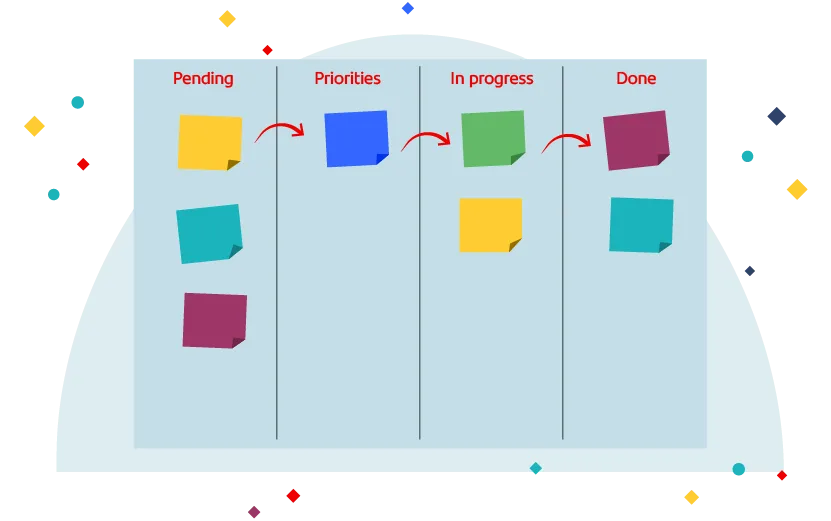
Three keys make Kanban work:
- Limit WIP (work in progress): don’t take on more than you can handle. Less is more.
- Visualize states: understand the status at a glance.
- Measure, with two durations that must not be confused.
| Metric | Definition |
|---|---|
| Lead time | from setting the goal (client request) to delivery. |
| Cycle time | from the moment a task starts being worked on to its completion. |
Marker : lead time contains cycle time. Lead includes the wait before starting, cycle counts only active work.
Revision sheet from the “Project Management & Agile Fundamentals” certification, Santander Open Academy. Diagrams from the course.