
Design Thinking is a user-centered approach to innovation. It gave rise to service design, business design and experience design (CX, EX, UX). Its engine fits in two alternating moves: explore widely, then decide.
diverge, converge
The whole process alternates two beats. Divergence opens up: you explore widely, you gather, you multiply the leads. Convergence closes: you synthesize, you decide, you refine. You repeat this beat at every phase, from research to ideation.
phase 1: research
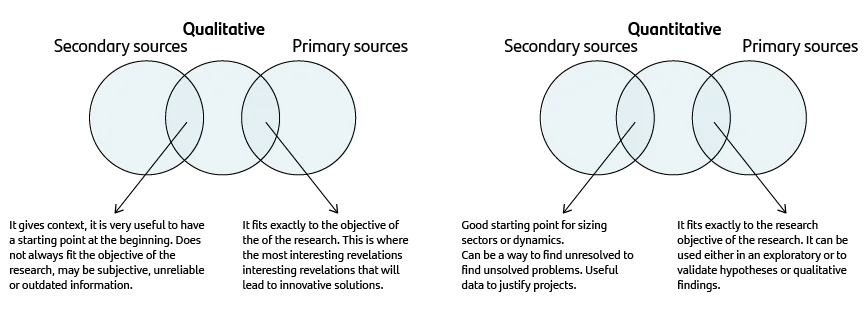
Goal: gather as much information as possible to understand the problem and the actors (user, client, company), by crossing sources. The techniques are mostly qualitative.
| Technique | Description |
|---|---|
| In-depth interviews | detailed one-on-one conversations about perceptions and experiences. |
| Surveys | a quantitative tool, by questionnaire across a large group. |
| Focus group | a guided group discussion on a specific topic. |
| Ethnographic observation | immersion to observe behaviors in their natural context. |
| Service safari | field exploration to experience the interaction as a user. |
| Shadowing | following a person along their journey, touchpoint by touchpoint. |
phase 2: synthesis
The pivotal stage: condense what you learned to trigger ideation. You sort into insights, opportunity areas, problems, and into pains, gains and motivations.
Empathy tools
- Stakeholder map: a map of the actors, from the most concerned to the most distant. Who to have an impact on, who to depend on, who to negotiate with.
- Persona: a fictional character, with a life story, to identify with.
- Customer journey: a person’s journey toward a goal, touchpoint by touchpoint.
Business strategy tools
| Tool | Description |
|---|---|
| Value curve | compares the offer to competitors on the market’s key factors, reveals axes of differentiation. |
| SWOT | strengths, weaknesses, opportunities, threats: internal and external view. |
| PESTEL | political, economic, social, technological, ecological, legal forces. |
| Porter’s forces | the five competitive forces that shape an industry. |
Example from the course : health insurance for young people: few subscriptions, for economic reasons (budget) and cultural ones (no chronic illness). The challenges become: “how to make it accessible to young people with limited resources?” and “how to make it attractive to healthy young people?“
phase 3: ideation
Once the challenge is understood, you look for solutions, again in two beats. Divergence explores widely, through varied techniques and multiple profiles. Convergence selects and refines the chosen ideas.

To sort, a simple matrix crosses impact and effort. It places each idea in one of four quadrants.
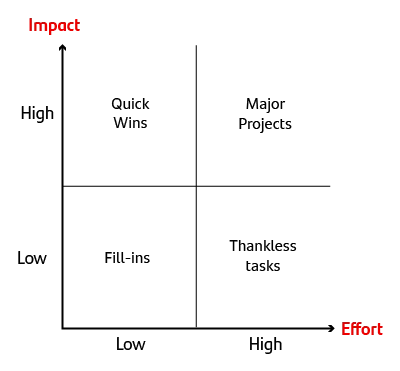
- Quick wins (high impact, low effort): do first.
- Major projects (high impact, high effort): to plan.
- Fill-ins (low impact, low effort): to fill the gaps.
- Thankless tasks (low impact, high effort): to avoid.
connecting design thinking, lean startup and agile
The three approaches don’t compete, they chain together. Design Thinking frames the problem (empathy, definition, ideation). Lean Startup tests the hypotheses through experiments (build, measure, learn, pivot or persevere). Agility, with Scrum, builds the solution sprint after sprint.
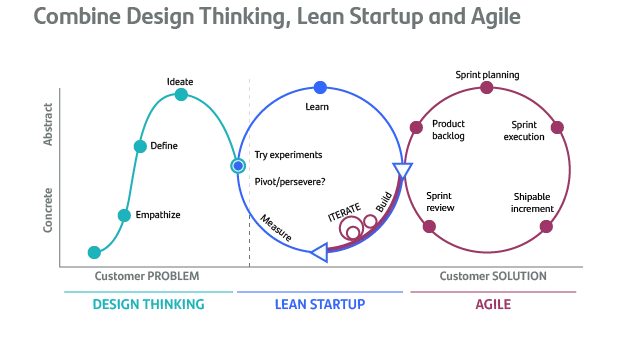
Remember : you move from the concrete (observing people) to the abstract (framing the right problem), then back to the concrete (shipping a product). Diverge to understand, converge to decide.
Revision sheet from the “Project Management & Agile Fundamentals” certification, Santander Open Academy. Diagrams from the course.