
Scrum is the most widespread agile framework. It breaks a project into short cycles, sprints, run by a team that organizes itself. This sheet gathers everything worth remembering, from the vocabulary to the classic traps.
where the word “scrum” comes from
The word comes from rugby: the scrum, where players lock together and push to win the ball. Nonaka and Takeuchi borrowed the image in the 1980s, observing teams at Fuji-Xerox, Canon and HP. In 1995, Schwaber and Sutherland applied it to software: a tight team, intense collaboration, a coordinated strategy.
self-managed teams
Scrum runs in sprints (from one week to two months) where the team works autonomously to produce a working version. It all rests on three “self-”.
| Principle | Meaning |
|---|---|
| Self-sufficiency | all skills and resources are in-house, no external dependency. |
| Self-management | no supervision during the sprint. No project manager, flat hierarchy, democratic decisions. |
| Self-inspection | the condition for self-management: transparency and visibility of the flow. |

Counter-intuition : done well, Scrum gives more control over the work and the quality than the classic model, because it no longer depends on a single external person. Limiting outside direction avoids loss of focus and the overhead of context switching.
sprints, MVP and increments
The sprint breaks the project into iterative cycles. We prioritize features (usefulness, criticality, commercial potential) to tackle the core of the product first and validate the real needs.
| Notion | Definition |
|---|---|
| Iterative | going back over what exists to fix and improve it. |
| Incremental | adding new features on top. |
| MVP | a basic but functional and commercially viable version: its value is enough for the client to pay. |

Each sprint ends on a working increment, assessable by the team and the client. The classic example: an MVP for hotel booking lets you search and find a hotel, without photos or payment. Those two functions are increments added after validation.
product-market fit and risk
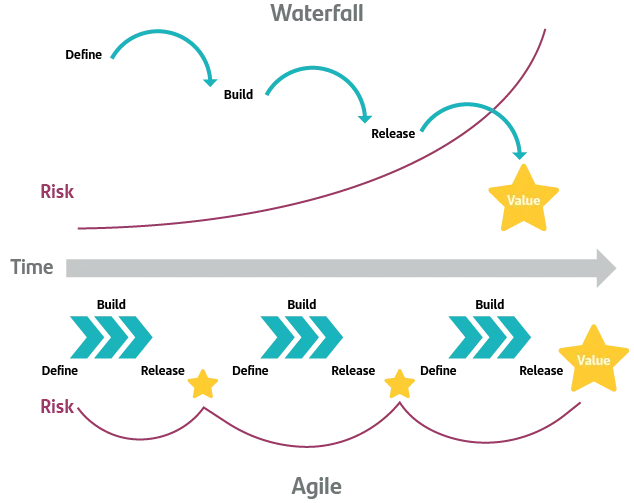
Product-market fit is the match between the product and the needs of a client who pays. Without a real, satisfied demand, the product fails. Scrum maximizes this fit through short sprints and constant validation.
| Model | Risk profile |
|---|---|
| Waterfall | all phases converge at the end, with no intermediate feedback. If the product misses the need, everything is lost. |
| Scrum | validation at each sprint: technical behavior and fit to the need are both tested. |
The bomb metaphor : risk grows along with the product. Waterfall only defuses it at the final delivery, Scrum defuses it a little at each sprint, while the value delivered keeps growing.
the roles
The Scrum Guide (Schwaber and Sutherland) formalizes roles, artifacts, events and vocabulary. It evolves and is updated regularly.
| Role | Image | Mission |
|---|---|---|
| Scrum Master | conductor | facilitates, removes obstacles, guarantees Scrum. No hierarchical authority. |
| Product Owner | translator | represents the business and the users, prioritizes the product backlog. |
| Development Team | craftspeople | self-organized and cross-functional, delivers quality increments. |
| Stakeholders | anyone with an interest in the project: feedback and prioritization. |
artifacts and user stories
| Artifact | Definition | Owner |
|---|---|---|
| Product Backlog | ordered list of everything needed, the single source of requirements. | Product Owner |
| Sprint Backlog | selected items plus the plan to reach the sprint goal. | Dev Team |
| Increment | the sum of the “done” items of the sprint and the previous ones, ready to use. | Dev Team |
The need is expressed as a user story, always on the same skeleton: as a (role), I want (feature) so that (benefit). A complete story holds in five elements: description, value (1 to 10), estimate (in story points), dependencies, and the Definition of Done agreed between the client and the team.
the five events
| Event | When | Duration | Purpose |
|---|---|---|---|
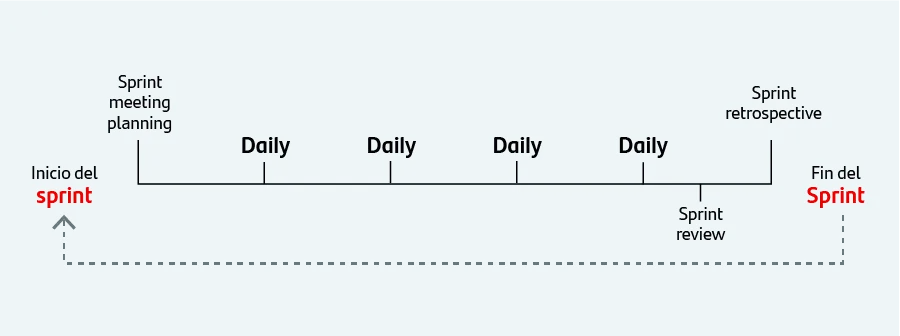
| Sprint | 2 weeks to 1 month | the heart of Scrum: reach the set goals. | |
| Sprint Planning | start | define the goal and select the backlog items. | |
| Daily Scrum | every day | ≤ 15 min | done yesterday, planned today, obstacles. |
| Sprint Review | end | with stakeholders: product review, next steps. | |
| Sprint Retrospective | end | the team’s self-assessment, ways to improve. |
Exam trap : the Review is about the product (with stakeholders), the Retrospective about the process and the team (internally). Don’t confuse them.
estimating: planning poker
The team estimates the effort of user stories by consensus. Planning poker uses cards inspired by Fibonacci (1, 2, 3, 5, 8, 13, 21…): small numbers for the simple and quick, large ones for complexity. The flow: present the story, discuss, vote simultaneously, then revote until consensus.

A few rules that protect the sprint:
- The Product Owner prioritizes the backlog continuously (value, criticality, strategy).
- During the sprint, the Dev Team works without interference: no new task imposed.
- The Scrum Master shields the team from external stakeholders.
- Only the Product Owner can decide to stop a sprint, and only in a serious case.
Revision sheet from the “Project Management & Agile Fundamentals” certification, Santander Open Academy. Diagrams from the course.